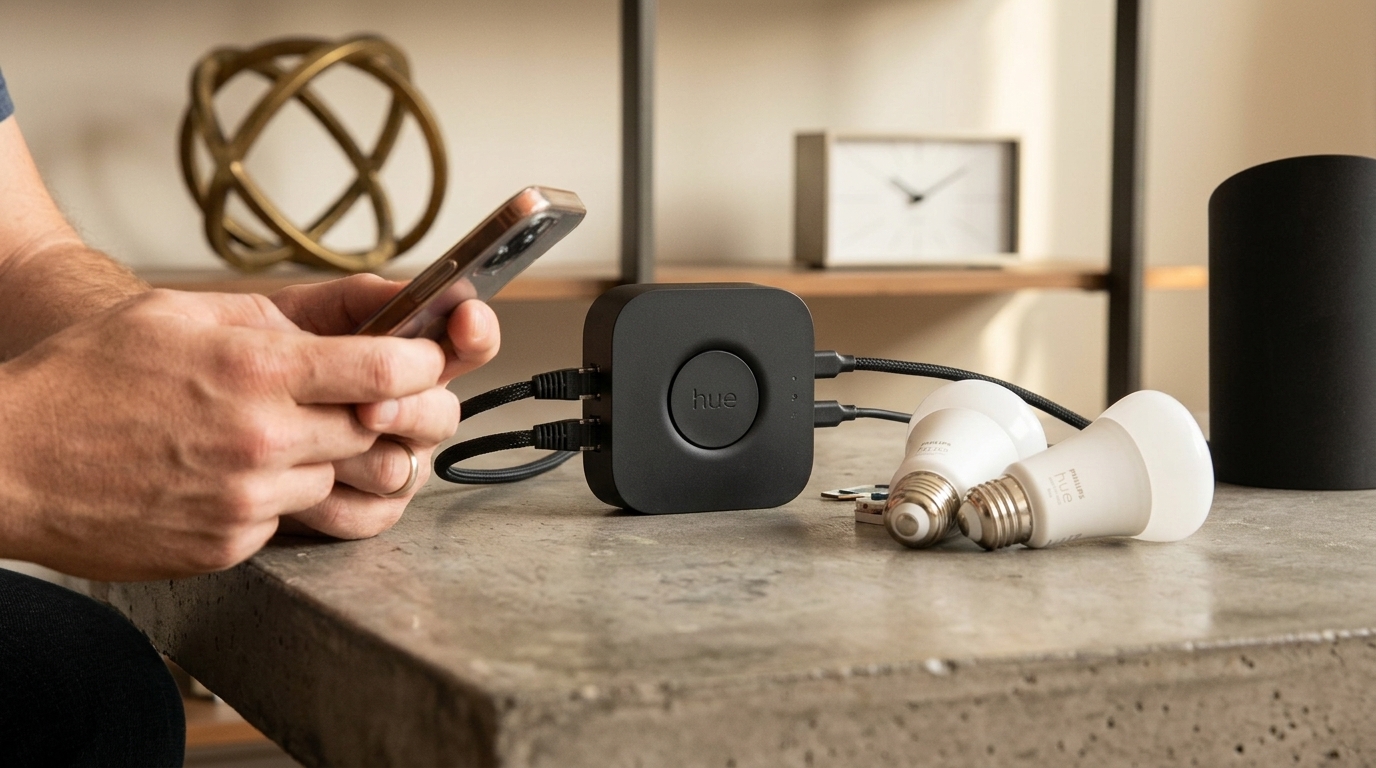
The history of smart lighting began in 2012 when Philips introduced the first Hue bulbs, effectively turning our smartphones into color remote controls. For years, the experience remained largely static: we would select a "scene," press a button, and the room would be flooded with light. However, the release of the Philips Hue Bridge Pro late last year and the introduction of SpatialAware technology mark the most significant evolution in the category in over a decade. It is no longer about controlling light; it is about light’s automated interaction with humans within a physical space.
The Revolution of SpatialAware and Bridge Pro
The central problem with traditional motion sensors (PIR) has always been their binary nature: they either detect motion and turn the lights on, or they don't and turn them off. This frequently led to frustrating moments where we had to wave our arms to avoid being left in the dark. SpatialAware, combined with the processing power of the Bridge Pro, changes this paradigm. Utilizing Ultra-Wideband (UWB) technology and advanced spatial mapping algorithms, the system doesn't just "see" motion; it understands the user's precise location within the room.
The experience is nearly magical. As you walk from the living room toward the kitchen, the light doesn't just snap on across the entire room. Instead, an "aura" of light follows you, increasing intensity where you are and dimming behind you. This dynamic response creates a sense of organic flow, making the technology feel invisible. The Bridge Pro acts as the "brain" of this operation, managing dozens of devices with near-zero latency—something the older Zigbee bridge struggled to achieve at such a scale.
From Gadgets to Ambient Intelligence
Why did it take so long to get here? The answer lies in the complexity of indoor geography. Our homes are filled with obstacles, walls, and furniture that block signals. Philips Hue invested in integrating the Matter protocol and Thread, but the real difference was made with SpatialAware. The system's ability to self-calibrate, recognizing room dimensions through the bulbs and sensors themselves, removes the burden of setup from the user.
In the past, "smart" lighting required us to be the programmers of our own daily lives. We had to define "if this, then that" rules. With SpatialAware, the logic shifts to Ambient Intelligence. The system learns our habits: if it's 3 AM and you're heading to the bathroom, the light will be a faint amber path. If it's 7 PM and you're walking in with groceries, the lighting will be bright and functional. This adaptability is what makes users appreciate color again—not as a gimmick, but as a tool for well-being.
The Cost of Perfection and the Ecosystem Challenge
Of course, transitioning to the Bridge Pro and adopting SpatialAware is not a cheap endeavor. Philips Hue remains the "Apple of lighting," with prices that often cause vertigo for consumers accustomed to $10 budget solutions. However, the value here isn't in the bulb itself, but in the software and reliability. The experience of never having to touch a light switch is a luxury that, once experienced, is hard to give up.
- The necessity of Bridge Pro: The legacy Bridge lacks the memory and processing power required for SpatialAware's complex calculations.
- Privacy: Unlike camera-based solutions, UWB offers precision without recording visual data of the occupants.
- Compatibility: The new system works seamlessly with Apple HomeKit and Google Home via the Matter standard.
In conclusion, SpatialAware is proof that smart lighting has matured. It is no longer a toy for changing colors at a party, but a fundamental infrastructure that improves quality of life in a subtle and meaningful way. Philips Hue has managed to make light "feel" our presence, and that is perhaps the most human achievement of home technology to date.