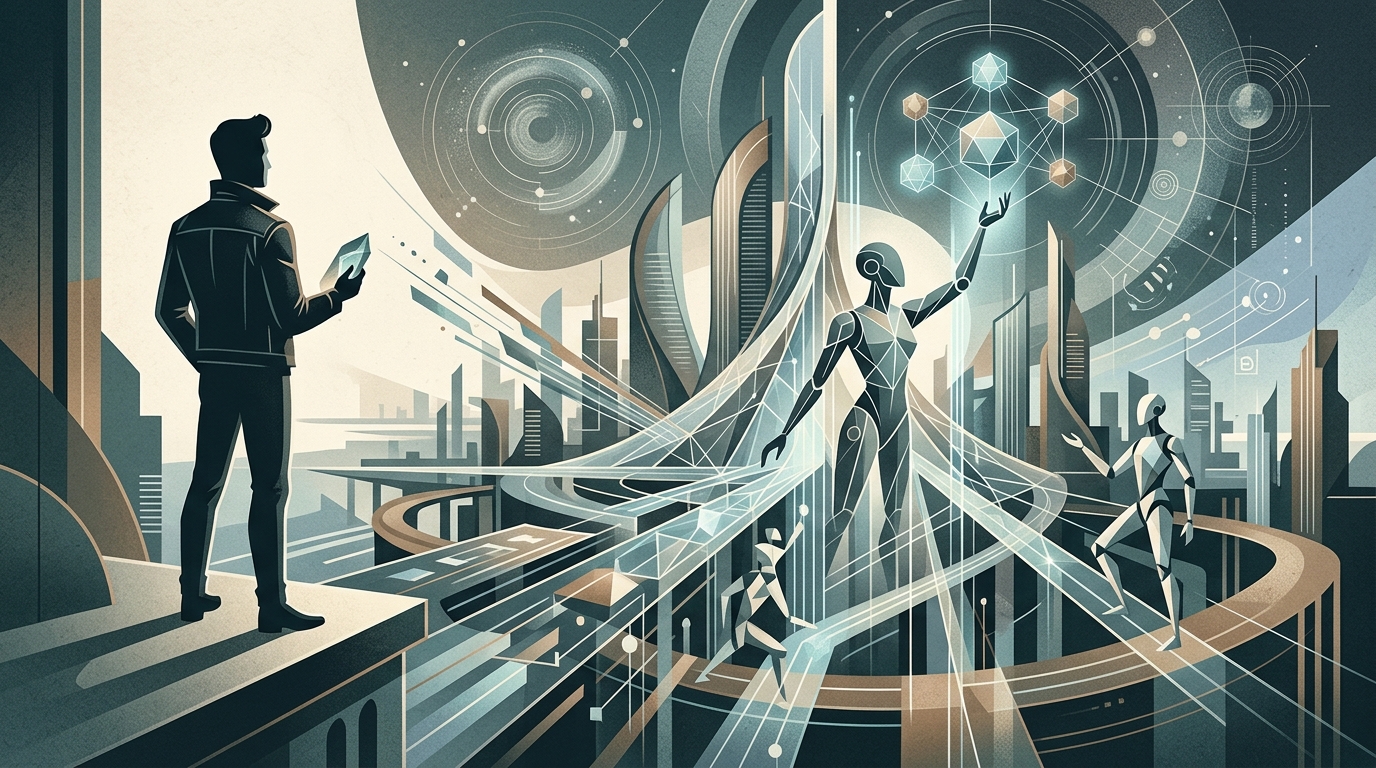
The history of writing is a history of technological revolutions. From Gutenberg’s printing press to the advent of the word processor, every new tool hasn't just changed the speed of discourse production, but the very structure of our thought. Today, we stand at the threshold of the most radical shift since the invention of the Phoenician alphabet. Artificial Intelligence (AI), through Large Language Models (LLMs), is no longer a mere correction tool but an active co-creator reshaping the DNA of written communication.
The Transition from Author to Curator
For centuries, writing was a solitary process of mining meaning from the chaos of human consciousness. The writer had to struggle with vocabulary, syntax, and structure. With the emergence of tools like ChatGPT and Claude, this process is shifting. The user no longer starts from scratch. Instead, they act as a "director" or "curator," providing guidelines and selecting the best version from multiple options offered by the machine.
This shift has profound psychological implications. "Blank page syndrome" seems to be receding, as AI can generate a draft in seconds. However, there is a risk of intellectual lethargy. When the machine offers a "good enough" solution, the human writer often abandons the effort to find the "perfect" word—the one that would give the text its unique, personal stamp.
The Democratization of Speech and the Homogenization Trap
One of the most significant benefits of AI in writing is the democratization of expression. People who struggle with writing, such as those with dyslexia or those required to write in a non-native language, suddenly gain a "voice" that is professional and coherent. In the business world, AI levels the playing field, allowing everyone to compose flawless emails, reports, and presentations.
However, this convenience comes at a price: homogenization. AI models are trained on the statistical average of human speech. The result is often text that is grammatically perfect but stylistically neutral—a "mushy" prose devoid of edge, humor, and authentic passion. If we all use the same tools to refine our texts, we risk ending up in a world where all writing sounds the same, losing the polyphony that characterizes human civilization.
Education and the New Ethics of Writing
In the field of education, the challenge is existential. For decades, the essay was the primary tool for assessing critical thinking. If a student can produce an essay with one click, what exactly are we evaluating? The answer lies not in banning the technology, but in re-evaluating learning itself. Writing is not just a way to transmit information; it is a way to organize thought. If we stop writing on our own, will we also stop thinking deeply?
Already, universities and schools worldwide are experimenting with new forms of assessment, emphasizing the process rather than just the final product. The ability to ask the right questions of an AI (prompt engineering) is emerging as a new form of literacy, as vital as spelling once was.
The Future: Human-Machine Symbiosis
The future of writing is not a battle between human and machine, but a symbiotic relationship. AI will take over repetitive and standardized tasks—legal documents, technical manuals, basic correspondence—freeing the human mind for more creative and complex pursuits. "Handcrafted" writing will gain new value, much like handmade goods became luxury items after the Industrial Revolution.
In a world flooded with AI-generated content, authenticity, personal experience, and emotional intelligence will be the elements that stand out. The challenge for us is to use technology to expand the boundaries of our expression without allowing the algorithm to define the limits of our thought.